







Our environmental commitment
Respect for the environment, and its preservation, is more than a commitment. It is a gift we make to ourselves and to future generations.
Change begins with us. For that reason, our choices have always been guided by a commitment to a form of sustainable development that safeguards our standards of quality and safety. Everyone who works in our group shares these values, and they shape our decisions every day.
OUR MANUFACTURING SITES
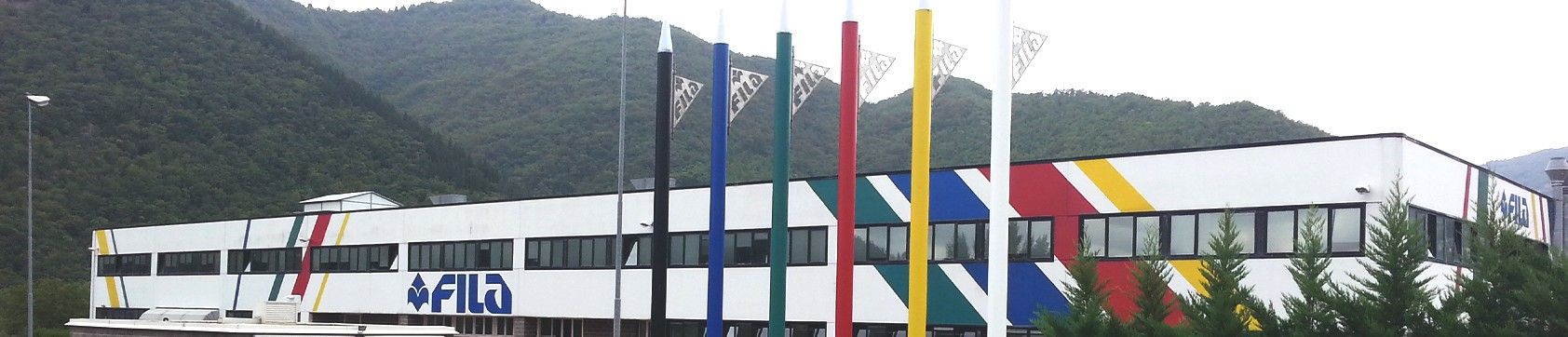
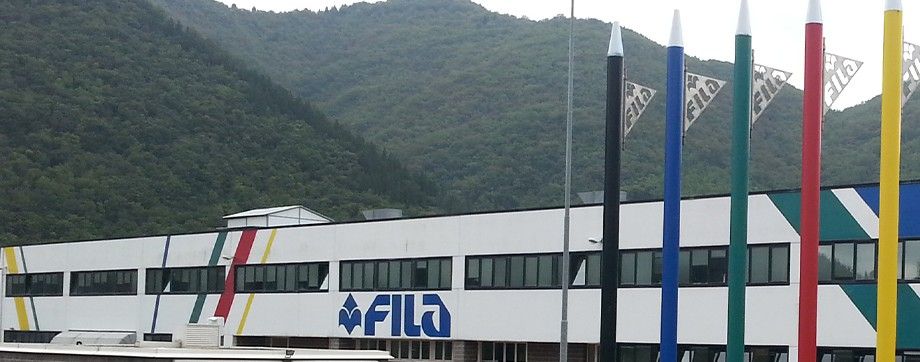
We operate our manufacturing activities with respect for the environment. This begins with monitoring how we use raw materials, our consumption of energy and water and our emissions, as well as keeping a close eye on how we dispose of our waste and our energy efficiency. We have built our factories far away from protected locations and sites with high levels of biodiversity, and we have implemented systems and processes that protect the environment, the local area and the ecosystem. Our production plants mainly employ electric energy, steam and natural gas for cooling processes and heating and we are continuously looking at ways of reducing our consumption. Today, one third of the energy needed to power our factories comes from biomass. To produce paper, tempera paints, play doughs and chalks, we use water. We constantly monitor our consumption of this important resource using automated systems that can limit its use to the absolute minimum.
THE INGREDIENTS THAT MAKE GREAT PRODUCTS.
At our facilities, we carefully select the raw materials and promote the use of raw materials from renewable sources with a low environmental impact.
The principal prime materials we use include wood, for pencils, coloured pencils, canvases and fibres for paper, plastic, for pens and felt tip pens, highlighters, accessories and containers, starch and flour, for papers and modelling pastes.
We carefully select raw materials and promote the use of those derived from renewable sources with a low environmental impact.
The main raw materials used by our Group include:
- wood (for pencils, coloured pencils, canvases and paper fibres);
- plastic (for pens, felt-tip pens, highlighters, accessories and containers);
- starch and flour (for paper and modelling pastes).
We have applied a sustainable approach to product development by introducing an internal protocol which establishes the implementation of solutions aimed at:
- promoting the use of raw materials from renewable, sustainable sources
- reducing packaging materials
- using eco-friendly packaging
- continually improving the performance of the products to increase their longevity and reduce waste
while complying with all safety legislation and guaranteeing top-quality products to our customers.
CLICK ON THE TOPIC BELOW TO DIG DEEPER AND DISCOVER MORE.
Wood from responsibly managed forests >
Plastic: an issue close to our hearts >
Every painting or drawing needs good paper >
Better quality means less waste >
A watchful eye on packaging >
Wood from responsibly managed forests >
Plastic: an issue close to our hearts >
Every painting or drawing needs good paper >
Better quality means less waste >
A watchful eye on packaging >
The certification chain for the source of the wood guarantees sustainable forest management and while biological diversity, forest renewal, natural catastrophe prevention, key habitat protection and a reduction in environmental impact due to forest exploitation will be ensured for future generations. Certified forests should fulfil their economic, ecological and social functions without compromising other ecosystems.
The wood goes through several steps before reaching you. The production chain is long and complex and must be documented throughout the entire process, from the tree to the finished product. For this reason, each link in the chain is essential to guarantee traceability through certification, which is why FILA has already introduced the use of wood and fibre from forests managed responsibly, correctly and sustainably.
Before reaching the finished product, wood passes through a long and complex supply chain that must be documented at every stage, from the tree to the final item. Each link in the chain is essential to ensure full traceability through certification. For this reason, FILA uses wood and fibres from responsibly and sustainably managed forests.
In order to reduce waste, a system for the recovery and reuse of wood waste is in place – waste from cuts which are a necessary part of pencil production – and in a move towards a circular economy, some of our ranges of pencils and frames for canvases are made with wood waste recovered through an industrial process.
To reduce waste, FILA plants have implemented systems for the recovery and reuse of wood scraps generated during pencil and canvas production. In line with circular economy principles, some pencil ranges and canvas frames are produced using recovered wood waste processed through industrial reuse systems.
Plastic is an essential raw material for guaranteeing the functionality, safety, longevity and cost-effectiveness of many products.
Most plastic currently available on the planet still comes from fossil fuels (oil) and is used in a wide range of sectors to make the many objects, items and components which we come across in our daily lives.
BIOPLASTICS
Bioplastics are divided into two broad groups:
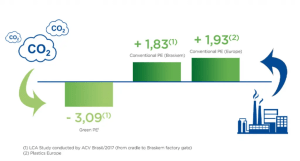
- bio-based plastics* which help to reduce CO2 and which are made with a renewable, non-fossil resource.
- biodegradable plastics produced from organic material or based on biodegradable synthetic polyesters which can break down quickly in the environment, in part due to their reduced thickness.
In our research and development departments, we study and test bio-plastics to understand their possible application for our products, the sustainability of their production, and the performance of the finished product.
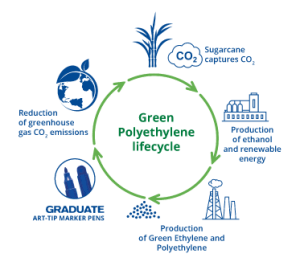
Starting from 2023, the bio-based plastic from sugar cane is used for a big new entry: the first marker pen made of bio-based plastic and made in Italy, Lyra Graduate ART-TIP. It is made with minimum 64% (barrel, plug and cap for the colored part) of bio-based plastic (or Green Polyethylene).
Since 2023, bio-based plastic derived from sugarcane has been used at the FILA plant in Rufina (Florence) to manufacture the LYRA Graduate ART-TIP marker, the first bio-based plastic marker made in Italy. It contains at least 64% bio-based plastic (barrel, plug and coloured cap), also known as green polyethylene.

*The renewable component or bio-based content in our products is scientifically proven and can be measured using the percentage of the 14C isotope, which is not present in petroleum plastics. The standard test method for this is ASTM 6866 which “determines the bio-based content of solid, liquid and gaseous samples using radiocarbon analysis”.
REGENERATED PLASTICS
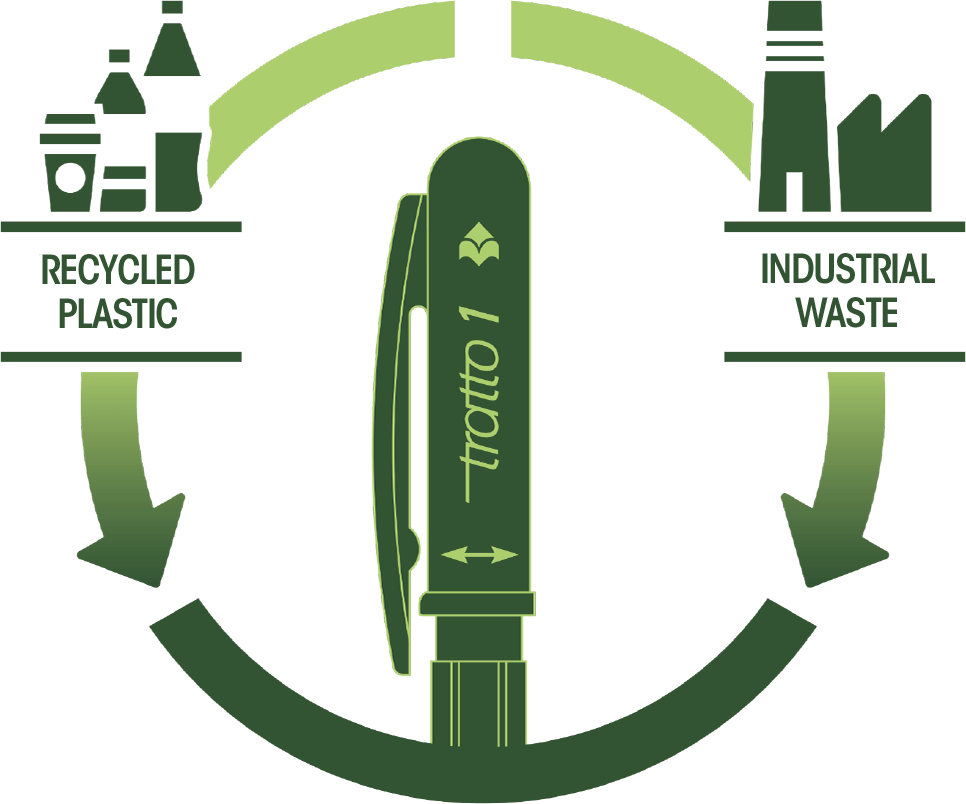
The group’s approach is to replace fossil-fuel-based plastics with more sustainable materials wherever possible. Recent examples include our Tratto1 ballpoint pens and Giotto Decor markers. These items use regenerated plastics from secondary raw materials and by-products—respectively: plastic materials from end-of-life waste recovery operations and industrial waste.
Moreover, we introduced these materials for the mass production of durable and semi-durable items as “schoolpack” pots used at school to hold felt-tip.
Furthermore, these materials have been introduced for the industrial production of durable and semi-durable items such as school packs, play jars and buckets, and tools for children.
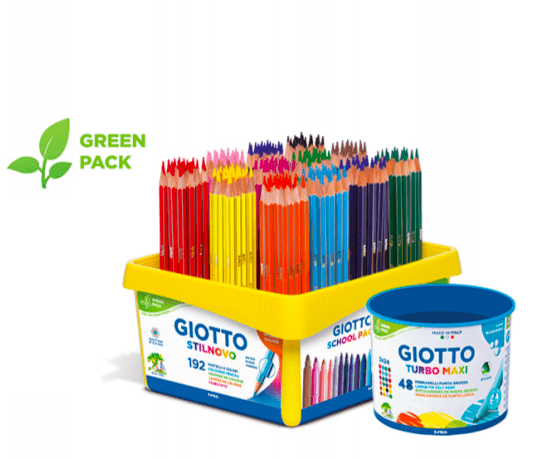
The % of regenerated plastic used for each product is clearly indicated on the packaging or communication materials and does not include the colouring part.
The percentage of regenerated plastic used for each product is clearly indicated on the packaging or in communication materials and does not include the coloring component
Water is the principal natural resource used in paper production.
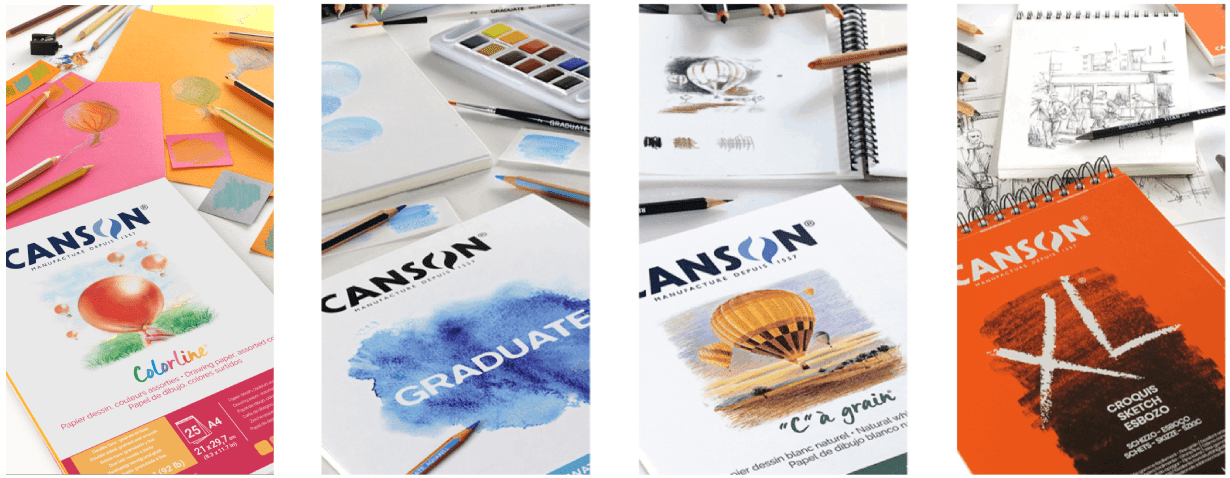
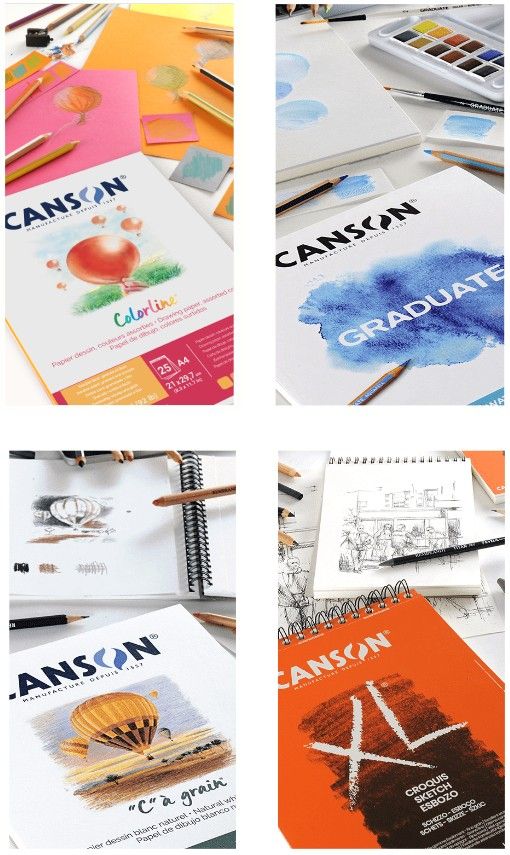
Canson® paper manufacturers, founded in 1500 and now part of the FILA group, use the pure waters of the Ardèche basin in France. The quality of the water supply is a priority for us. The rivers around Canson® have been rated category 1 (classed as “excellent quality”) by the French water board, the Agence de l’Eau.
For production, only water-based ink is now used for the printing of Canson® folders, drawing paper and graph paper. In addition, for collated blocks we use a neutral glue that, besides its environmental benefits, allows optimal preservation of one’s works. During product design, we try to minimize waste generation at the source. Our effort has focused on diminishing the percentage of wasted paper:
- by optimizing production and spool length,
- by reducing kerfs,
- by improving and making reliable the functioning of our equipment.
The raw materials for Canson paper for students and artists, like the Giotto paper produced at the Canson paper mill, use fibres from an FSC® certified chain and a biomaterial, starch, essential for increasing the paper’s resistance to ripping and tearing, for bonding the surface through sizing, and preventing the occurrence of dusting. Find out more at canson.com
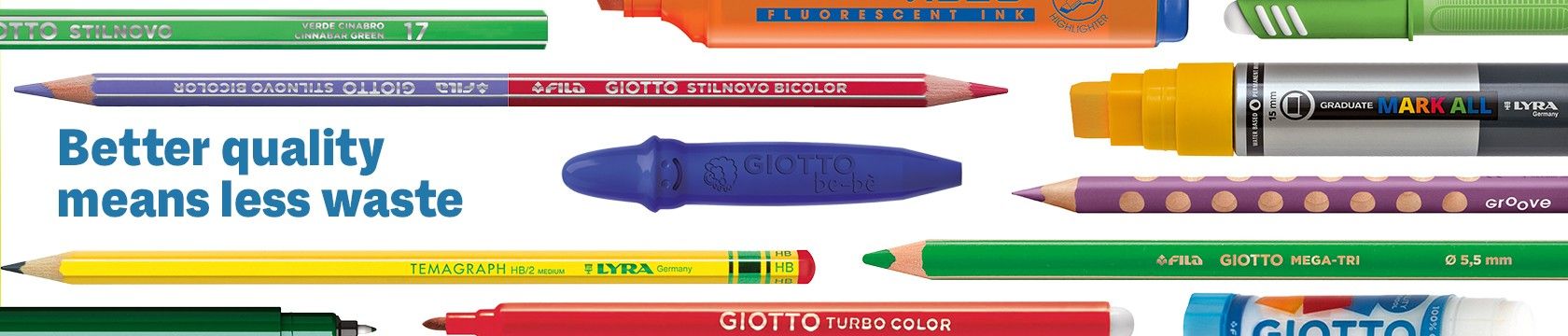
Longevity and performance are both aspects which influence waste reduction: we follow this philosophy in everything we do, every single day. To give just a few examples: our felt-tip pens last longer because we choose fibre tips which are both soft and durable, retain their shape, and allow the ink contained in the reservoir to be used up completely. The felt-tip pen inks have bright colours and do not dry out even if the cap is left off for several days. The pencils and coloured pencils are made with highly pigmented solid cores which deliver instant colour to the paper, while wearing down slowly. The glue sticks do not disintegrate, are compact and deliver just the right amount of glue to the paper for optimum usage; the poster paints are rich and concentrated and a small quantity offers excellent results; the pens, highlighters, and markers have a large ink reservoir and will last for a long time.
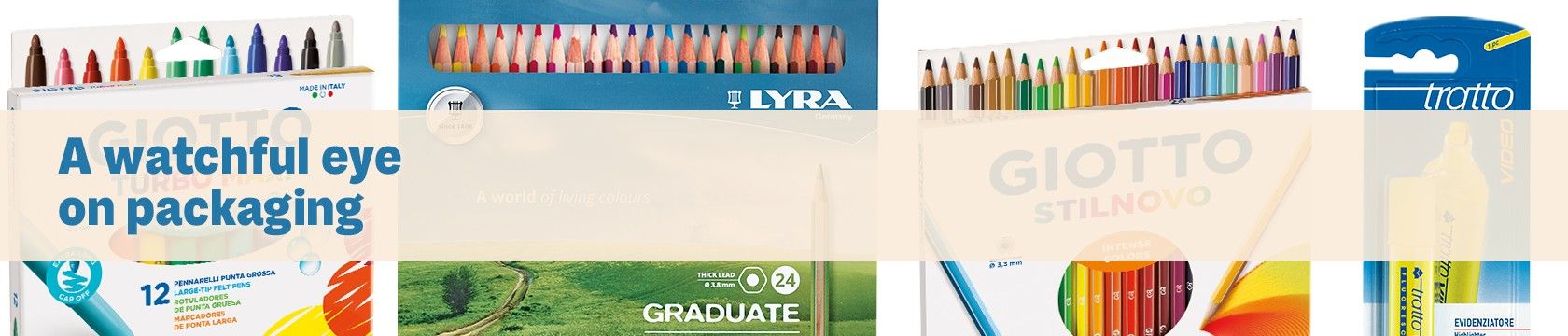
The choice of materials used for packaging is another crucial aspect for a sustainable future.
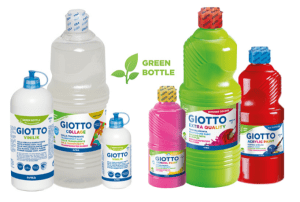
We are continuously working to reduce the environmental impact of packaging we purchase or manufacture ourselves.
Examples include:
- GIOTTO tempera paint bottles (Extra Quality, Schoolpaint and Acrylic – 250 ml, 500 ml and 1000 ml) made with at least 30% recycled plastic;
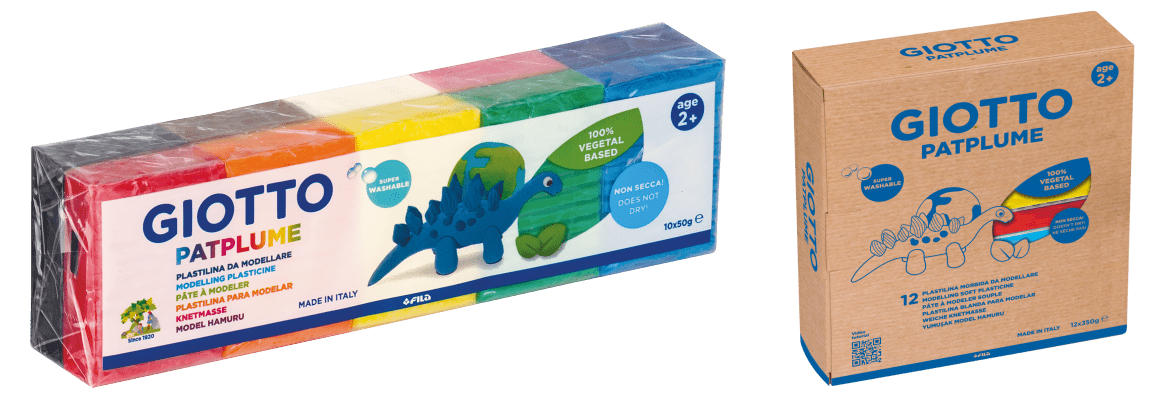
- a rationalisation of modelling clay packaging, including the iconic Giotto Patplume, avoiding the use and transport of 4.7 tonnes of cardboard per year;
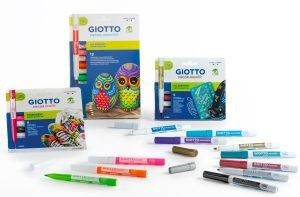
elimination of plastic from Giotto Decor marker packaging, reducing cardboard consumption and avoiding the use of 300,000 plastic trays.
Many small actions make for a great result.